


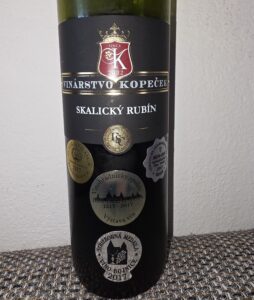
 Skalický Rubín is one of Slovakia’s traditional red wines, with an identity closely tied to a specific region and its local viticultural history. Its origins date back to the first half of the 20th century, and its character is derived from a blend of three red grape varieties: Frankovka modrá (Blaufränkisch), Svätovavrinecké (St. Laurent), and Modrý Portugal (Blauer Portugieser). The 2016 vintage from the Kopeček winery represents an older release of this regional specialty from Skalica, located in the Záhorie region.
Skalický Rubín is more than just the name of a red wine; it is a traditional branded wine with a Protected Designation of Origin (PDO), the production of which is restricted to a defined area surrounding the town of Skalica. Its character combines the fruitiness of the red grape varieties with a firmer structure, tannins, and acidity – elements essential to the wine’s overall harmony.
The foundation of Skalický Rubín is Frankovka modrá, complemented by the Svätovavrinecké and Modrý Portugal varieties. According to the regulations for its Protected Designation of Origin, Frankovka modrá must account for at least 70% of the blend.
Frankovka modrá is a Central European grape variety with a long history of cultivation – most notably in Austria, Moravia, and Slovakia, as well as in other countries that were once part of the Habsburg Monarchy. Depending on the vineyard site and the ripeness of the grapes, it produces wines with aromas of cherries, sour cherries, and dark forest fruits. Its natural acidity and tannin structure help create wines capable of evolving during bottle aging.
The Svätovavrinecké variety, also known as Saint Laurent, is characterized by a darker fruit profile. On the nose and palate, one may detect notes of sour and sweet cherries, sometimes accompanied by spicy or earthy undertones. In a blend, it contributes to fullness and an intense fruity character.
Modrý Portugal is a traditional Central European red grape variety, most prevalent in Austria, Moravia, and Slovakia. It typically yields more accessible wines with a softer structure and fruit-forward notes. In a blend, it can temper the profile of more assertive varieties, fostering harmony among them.
The combination of these three varieties results in a wine whose identity is not defined by a single varietal aroma, but rather by a balanced interplay of fruitiness, acidity, and tannins. This specific combination forms the foundation of the traditional Skalický Rubín.
The town of Skalica boasts a long-standing viticultural tradition. The earliest surviving written record regarding the establishment of vineyards within its territory dates back to 1450. Vineyards flourished around the town, and their specific locations, soil conditions, and local climate gradually shaped the character of the wines produced there. The branded wine *Skalický Rubín* began to gain prominence in the 1920s, with its origins linked primarily to the year 1924. Its spread was driven, in part, by the need to supply customers with a wine of consistent character. By blending several grape varieties, winemakers were able to achieve greater stability across different batches and vintages. A significant milestone was reached in 2018, when the wine was granted a Protected Designation of Origin (PDO) status by the European Union. Consequently, the name *Skalický Rubín* cannot be applied to just any red wine; its production is restricted to a specific geographical area and a strictly defined set of grape varieties. For the town of Skalica, this wine is an integral part of the local identity—much like the historic wine cellars that have been preserved in the region in significant numbers. Thus, *Skalický Rubín* represents not only a distinct style of red wine but also the culmination of the long-term evolution of local viticulture and winemaking.
The family-run Kopeček Winery was officially established in 2002, though its history runs much deeper. In 1939, František Kopeček—the grandfather of the current winemaker—planted the family’s first vineyard in the *Novosady* locality and built a wine cellar that remains in use to this day. The family tradition of viticulture was interrupted during the era of the collectivization of agriculture, when the original vineyards in Novosady were uprooted in the 1970s and the land was repurposed for growing agricultural crops. Viticulture was revived in this area in 2008, when the town of Skalica planted new vineyards. The Kopeček winery focuses primarily on regional wines from the Skalica viticultural district. It manages approximately five hectares of vineyards in the Novosady locality, situated on a southwest-facing slope above the town. The soil consists predominantly of clay and shale. In addition to traditional red wines, the winery produces white and rosé wines, as well as specialty products, including orange wines. Production is based on classic reductive winemaking techniques, though the winery also maintains a cellar equipped with wooden barrels for aging wine. A key aspect of their approach is the hand-harvesting of grapes, with the timing of the harvest determined by the specific ripeness of each variety. In the case of “Skalický Rubín” (Skalica Ruby), the family winemaking tradition converges with the regional identity of the town. It is precisely this combination that makes the wine a compelling part of Slovakia’s viticultural heritage.
Here is a description of the wine:
Skalický Rubín 2016 is characterized by a ruby-red color, from which the wine derives its name. In younger wines, this hue tends to be more intense, whereas in older vintages, it may gradually shift toward brick or even brownish tones. For the 2016 vintage, one must consider the time that has elapsed since the harvest; after approximately ten years, the evolution of the color serves as an indicator of the wine’s maturation.
The typical aromatic profile of Skalický Rubín 2016 is primarily defined by dark and red fruits. The nose may reveal notes of sour cherries, sweet cherries, and plums—with hints of plum jam appearing in more mature examples. With extended bottle aging, the initial fruit aromas gradually evolve into earthy nuances, notes of dried fruit, or subtle spicy undertones.
The character of Skalický Rubín 2016 is built upon a fuller body, pronounced tannins, and natural acidity. Frankovka modrá (Blaufränkisch) contributes structure and fruitiness to the blend, while Svätovavrinecké (St. Laurent) and Modrý Portugal (Blauer Portugieser) round out the wine’s overall profile. On the palate, the wine mirrors its bouquet – featuring sour cherries, sweet cherries, and plums, which, as the wine matures, transition into notes of dried fruit. The tannic structure also plays a significant role; in a well-matured wine, these tannins are seamlessly integrated into the overall flavor profile. The alcohol content is 12.5% vol. This represents a moderate level, which, in a well-balanced red wine, enhances its body without creating an overly warming sensation. However, alcohol should always be considered in the context of the wine’s acidity, tannins, and extract.
The recommended serving temperature is 14–16°C. For older red wines, it is best to avoid serving them at high room temperatures, as the alcohol can become too prominent and mask more delicate aromatic notes. It is advisable to open the bottle in advance and taste the wine before deciding whether to decant it; if the wine has already reached its peak maturity, prolonged decanting could accelerate the loss of its fruit characteristics.
Skalický Rubín 2016 pairs naturally with dishes that can balance its fruitiness and tannins. Excellent choices include game, roasted dark meats, and traditional cuisine from the Záhorie region.
Recommended pairings include: roasted game (such as venison or roe deer) served with a delicate wild-berry sauce; beef dishes – such as slow-roasted beef, beef braised in red wine, or stews; roasted duck or goose served with red cabbage; aged cheeses (semi-hard or hard varieties with a pronounced flavor profile); and goat cheese – specifically more mature types with a fuller, richer taste. For older vintages, it is advisable to opt for simpler meat preparations rather than dishes featuring heavily sweet sauces or intense spices. The goal is to avoid asking the more delicate notes that develop during bottle aging.
The Kopeček Winery has received the following awards for its Skalický Rubín:
- Gold Medal – Festival of Royal Wines 2023, Skalica;
- Silver Medal – Texas International Wine Competition 2024;
- Silver Medal – AWC Vienna 2024.
Skalický Rubín 2016 from the Kopeček Winery is a wine whose significance extends beyond what is inside the bottle. It is an integral part of a regional winemaking tradition that has taken shape in Skalica over many decades. It is based on a traditional blend of Frankovka modrá (Blaufränkisch), Svätovavrinecké (St. Laurent), and Modrý Portugal (Blauer Portugieser), with its final character emerging from a balance of fruitiness, acidity, and tannins.
An interesting aspect of this particular vintage is its age. After approximately ten years, it offers a more mature and complex expression than younger wines. Skalický Rubín serves as a prime example of how a traditional Slovak cuvée has become woven into the identity of a specific wine-growing region. At the same time, the 2016 vintage provides an opportunity to observe how this regional blend evolves over time.
#tipnavino #slovenskecervenevino #vinozozahoria #skalickevinohradnictvo #vinarstvokopecek #skalickyrubin


