
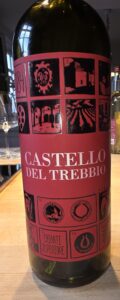
 We bought the wine in a small shop near Stuttgart and drank it during dinner with our business partners. Smooth and pleasant. It was very easy to drink and complemented the dinner meal nicely.
The wine Castello del Trebbio Chianti Superiore DOCG comes from the historic Chianti region in Tuscany, one of the most famous wine regions in Italy. The wine is based on the Sangiovese variety, which forms the backbone of classic Chianti wines. Sangiovese is one of the oldest cultivated varieties on the Apennine Peninsula and its name is often interpreted as “sanguis Jovis” – the blood of Jupiter. It has been cultivated in Tuscany since at least the Middle Ages and, thanks to the local climate and calcareous-clay soils, produces wines with typical acidity, cherry aromas and a distinct tannin structure.
The Castello del Trebbio winery is located in the hilly countryside northeast of Florence, in the Rufina area. The estate itself has an exceptionally long history – the original castle was built in the 12th century and over the centuries it has belonged to several important Florentine families. One of the most interesting historical moments is the connection with the Pazzi family, who made history with the famous conspiracy against the Medici family in 1478, known as the Pazzi Conspiracy. Today the winery is run by the Baj Macario family, who have gradually modernized the vineyards and cellar management while preserving the historic character of the estate. The vineyards are managed with an emphasis on ecological principles and respect for the local terroir. Castello del Trebbio is among the producers who emphasize the authenticity of the Chianti Rufina area – a smaller but often very high-quality subzone of Chianti.
The winery operates within the Biointegrale® system, which means that the approach to growing vines and making wine combines the principles of organic (bio) farming with elements of integrated viticulture and an emphasis on the biodiversity of the entire vineyard ecosystem. The essence of the Biointegrale system is that the vineyard is not perceived only as an agricultural area intended for grape production, but as a complex biological system. The goal is to create a balance between plants, soil, microorganisms, insects and the surrounding landscape. The main principles of Biointegrale are – Organic viticulture; Support for biodiversity; Soil care; Minimization of interventions in the cellar and a Total ecological approach. In practice, the Biointegrale® designation means that the winery strives to produce wine in a way that is environmentally friendly, respects natural processes and at the same time preserves the typical character of the vineyards and the region. This is an approach that stands between classic organic viticulture and the broader concept of regenerative agriculture.
In Chianti Superiore DOCG Sangiovese forms the dominant part of the blend (Sangiovese 85%, Canaiolo + Ciliegiolo 15%). The addition of other varieties softens the wine and broadens its aromatic profile. The grape harvest is machine-harvested to ensure a quick harvest of grapes with perfect ripeness. After destemming, the berries are gently pressed. The mash is then cooled to a temperature of 10–12°C for 1 or 2 days in stainless steel tanks. Alcoholic fermentation begins with natural yeasts and maceration lasts 15 days. Malolactic fermentation takes place without the addition of additional lactic yeasts. The wine is then aged as follows – 50% of the wine in 20 hl Slovenian oak barrels for 12 months, and the remaining 50% in stainless steel tanks for 12 months. The wine’s aging potential is best within 5 years of harvest.
Here is the wine description:
The wine has a ruby red color of medium to high intensity. With increasing maturation, it can turn into garnet shades typical of wines based on the Sangiovese variety.
The aromatic profile shows typical notes of red cherries, sour cherries and forest fruits. They are complemented by delicate spicy aromas, a hint of dried herbs, sometimes tobacco, or a hint of leather, which is characteristic of traditional Chianti. After maturation in wood, notes of vanilla and soft toast are also noticeable.
The taste is dry, medium-full to fuller, with typical fresh acidity and a firm tannic structure. The fruity notes of cherries and plums are complemented by a subtle spiciness. The finish is medium to long, with the characteristic freshness typical of wines from the Chianti region.
Alcohol is 13% vol.
The ideal serving temperature is 16–18 °C. In younger vintages, a short decantation can help develop the aromatic profile of the wine.
The wine pairs well with traditional Italian cuisine. It is suitable for pasta with tomato sauces, beef dishes, roasted lamb, or mature hard cheeses. It also goes well with dishes typical of Tuscan cuisine, such as ragù or grilled meat.
Wine from the Castello del Trebbio winery regularly appears in the reviews of major wine guides, such as Wine Spectator, James Suckling, or the Italian guide Gambero Rosso, which confirms the stable quality of the production of this historic Tuscan producer.
Castello del Trebbio Chianti Superiore DOCG is a typical example of a classic Tuscan wine based on the Sangiovese variety. It combines fresh acidity, red fruit and the traditional spicy character of Chianti. The wine reflects the terroir of the Chianti Rufina region and at the same time the long winemaking tradition of the Castello del Trebbio estate, which is one of the historically significant wineries around Florence.
#tipnavino #italywine #chianti #sangiovese #chiantisuperiore #castellodeltrebbio


