
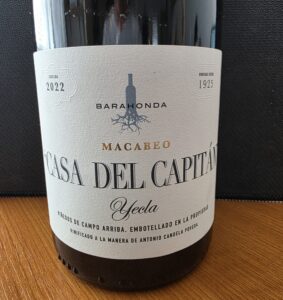
 Today again Spanish wine from another variety widespread in Spain – Macabeo. Macabeo Casa del Capitán 2022 is a dry white wine from the D.O. Yecla appellation in the Murcia region in southeastern Spain. The wine is made from 100% Macabeo and belongs to the Casa del Capitán line of the Bodegas Barahonda winery. The wine is labeled as suitable for vegans and vegetarians.
Macabeo is one of the most important white grape varieties in Spain. In different regions, other names are also used, such as Viura, Macabeu, or Maccabeu. The synonym Viura is typical mainly for Rioja, while the name Macabeo is used mainly in Catalonia and other parts of Spain. In the French wine region of Roussillon, the designation Macabeu is used. Macabeo also has an important position in the Catalan region of Penedès, where it has become one of the three basic varieties used in the production of Cava. Together with the Xarel-lo and Parellada varieties, it forms the traditional varietal trio of Catalan Cava. During secondary fermentation in the bottle, Macabeo provides the wine with freshness, delicate aromas and fruity character, while Xarel-lo adds structure and Parellada with elegance and fragrance.
The viticultural potential of Macabeo is particularly interesting due to its ability to maintain freshness and at the same time respond well to aging. The variety has large and compact bunches, thicker skin and later ripening. Depending on the growing conditions, it can provide wines with citrus and fruity character, but also fuller wines suitable for aging in wood. Macabeo is a very interesting choice for Yecla, which is especially known for the blue Monastrell variety, which is very well adapted to the dry and warm climate of Murcia (note – on 14.06.2026 I published a description of the Monastrell wine also produced in this winery). Macabeo shows another side of the local terroir – freshness, citrus aromas and the ability to create a white wine with sufficient structure despite the hot Mediterranean climate.
The D.O. Yecla is located in the region of Murcia, in the transition zone between the Spanish plateau and the Mediterranean Sea. The vineyards are located at an altitude of approximately 400 to 800 meters above sea level. The higher vineyards of the Campo Arriba area reach approximately 700–800 meters, while Campo Abajo is located at an altitude of approximately 400–500 meters. The Yecla region is characterized by a continental climate with Mediterranean influences and significant differences between day and night temperatures. Hot and dry summers are compensated by cooler nights, which slows down the ripening of the grapes and thus helps to preserve the acids.
The region’s vineyards are often poor and have a significant amount of limestone, which, together with low rainfall, creates truly challenging conditions for the vine. But it is precisely the combination of altitude, dry climate, limestone soils and large temperature differences that give the wines of Yecla their specific character.
The history of the Barahonda winery is closely linked to the Candela family. Its winemaking roots date back to around 1850, when Pedro Candela Soriano began producing and selling small quantities of wine locally in Yecla. In 1925, his son Antonio Candela García founded a small family winery. Later, its development was taken over by Antonio Candela Poveda, who gradually expanded and modernized the business. In 2006, Bodegas Barahonda was founded as a modern winery, which is now run by Antonio and Alfredo Candela, representatives of the fourth generation of the family. The aim was to move the family tradition towards higher quality production while maintaining a link to the local vineyards and terroir of Yecla. The modern Barahonda winery is surrounded by vineyards and its architecture uses simple geometric lines as well as traditional materials. The winery produces wines from varieties typical of Yecla, but also works with other Spanish and international varieties. The basis of this winery’s production is Monastrell. In the production of white wines, it uses Macabeo, Verdejo, Airén and other varieties.
Casa del Capitán Macabeo 2022 is a 100% varietal wine. After the selection of the grapes, gentle pressing and maceration of the must are followed before fermentation itself. Alcoholic fermentation takes place in stainless steel tanks. Subsequently, the wine undergoes malolactic fermentation in French oak barrels, where it remains for approximately eight months. This technological process is interesting for Macabeo. The variety is naturally suited to producing crisp white wines, but eight months in French oak gives it greater texture and complexity. The wood is not the dominant element of the wine, but complements the fruity and citrus aromatics with a slightly spicy and creamy character.
Here is the description of the wine:
The wine has a light golden yellow color with subtle greenish reflections. The appearance corresponds to a younger white wine, although the eight months in French oak wood give it a slightly fuller visual impression.
The nose is dominated by fresh citrus fruits, especially lemon and grapefruit, complemented by notes of white fruit. Gradually, subtle notes of wood are added, resulting from the aging in French oak barrels. The aroma remains fresh and fruity, the wood complementing it rather than covering it.
In the mouth, the wine is fresh, with well-preserved acidity and adequate structure. Citrus fruitiness follows the nose and a subtle creaminess and a subtle influence of oak wood are gradually added. Malolactic fermentation and subsequent barrel aging give the wine a broader mouthfeel, while the acid remains its main refreshing component.
Casa del Capitán Macabeo 2022 is not a typical light and exclusively fruity Macabeo. The aging in French oak adds structure and complexity, while maintaining the characteristic freshness of the variety.
The alcohol (12% vol.) is well integrated in this wine and, due to the fresh acidity, it does not feel heavy or warm.
The recommended serving temperature is 7–9 °C. At a lower temperature, its aromatics and the influence of the wood will be suppressed. At a temperature of around 8 °C, the balance between citrus freshness, acidity and structure obtained from aging in oak barrels is better expressed.
Thanks to the combination of acidity, citrus freshness and a slightly creamy structure, Macabeo Casa del Capitán 2022 is particularly suitable for fish and seafood. However, fattier fish, such as sea bream, red sea bass or mackerel, are also a good choice. It is also interesting to pair with poultry, especially roasted or grilled chicken. Thanks to its aging in French oak, it can also handle more substantial dishes. The winery also recommends special Iberian pork cuts pluma and secreto.
It is also suitable for smoked fish, lighter appetizers, pasta with a creamy sauce, or dishes that require a wine with greater freshness and at the same time a certain structure.
Macabeo Casa del Capitán 2022 is a truly interesting example of how the Spanish white variety Macabeo can be interpreted in the conditions of D.O. Yecla. Instead of a simple young wine based only on fruitiness, it offers a combination of citrus freshness, good acidity, creamy texture and a subtle influence of French oak. The greatest advantage of the wine is the balance between freshness and structure. Macabeo retains its natural fruitiness and acidity, while eight months in French oak barrels add another layer of complexity to the wine. The result is a dry white wine from Yecla that can also appeal to those looking for a fuller Spanish white wine but don’t want to give up freshness.
#tipnavino #spanielskevino #spainwine #vinhoyecla #barahonda #macabeo


