

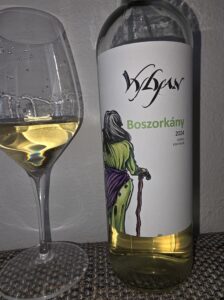
 I bought the wine at a shop in central Budapest while waiting for a train. Although the label initially caught my eye, the name “Boszorkány” (meaning “Witch”) convinced me there was something interesting about it—and indeed, there was. I originally opened the wine to use as an ingredient for turkey with mushrooms and cream sauce. Upon opening the bottle, I was immediately struck by its delicate, pleasant aroma. It is a truly light, enjoyable wine; while it likely has a higher level of residual sugar, it still falls within the dry category. I finished the wine that same day, as it was incredibly refreshing in the heat.
Boszorkány is a crisp, dry white wine from the Hungarian winery Vylyan Pincészet, located in Villány — one of Hungary’s southernmost and warmest wine-growing regions. It ranks among the winery’s lighter, fruit-forward offerings. It is based on white grape varieties typical of Central Europe, with Olaszrizling and Rajnai Rizling (Rhine Riesling) playing the dominant roles.
The Boszorkány 2024 is a blend consisting of 50% Olaszrizling, 35% Rajnai Rizling, 9% Cserszegi Fűszeres, and 6% Chardonnay. The individual varieties were processed and fermented separately in stainless steel tanks at 16–18°C and were blended in these proportions only after fermentation was complete. The wine did not undergo malolactic fermentation, thereby preserving its natural acidity. Olaszrizling — is a significant Central European white grape variety. Despite its name, its origins are not definitively linked to Italy; the variety’s genetic lineage remains a subject of debate, and it is now considered a variety typical of the Carpathian Basin. It is known as “Welschriesling” in Austria and Germany, and as “Graševina” in Croatia. It is a completely different variety from the classic Rheine Rizling, and there is no direct kinship between the two.
In contrast, Rajnai Rizling —originates from the Upper Rhine region and ranks among the most important white varieties in Western and Central Europe. It is characterized by pronounced acidity, an ability to retain freshness even in warmer conditions, and typical aromatic notes of citrus, green apple, and stone fruit, as well as more complex petrol notes as it ages. It spread to Hungary from German wine-growing regions.
I will devote a little more attention to describing the “Cserszegi Fűszeres” variety. It is an aromatic Hungarian white wine grape variety created in the second half of the 20th century by crossing “Irsai Olivér” and “Rizling Silván” (Sylvaner). It was bred by Károly Bakonyi in Kecskemét, Hungary, and registered in 1960. The name “Cserszegi” refers to the village of Cserszegtomaj near Lake Balaton, while “fűszeres” means “spicy” in Hungarian. The variety’s genetic makeup combines two distinct traits: Irsai Olivér lends it pronounced aromatics and early ripening, while Rizling Silván contributes to the vine’s structure, acidity, and resilience. Consequently, Cserszegi Fűszeres is known for producing white wines that are highly aromatic yet fresh. In the case of Boszorkány 2024, Cserszegi Fűszeres makes up 9% of the blend. Although its share is modest, this variety is a key source of the wine’s floral and spicy aromatic notes. Combined with Olaszrizling, Rajnai Rizling, and Chardonnay, it enhances the blend’s fresh foundation with a more pronounced fragrance.
Villány is located in southern Hungary, in Baranya County, and ranks among the country’s warmest wine-growing regions. The vineyards primarily occupy the south- and southeast-facing slopes of the Villány Hills. The region experiences a distinct sub-Mediterranean influence, boasting over 2,000 hours of sunshine annually and a long growing season. Geologically, the area is characterized mainly by limestone, which is overlaid in many places by loess and loess-derived soils.
The history of viticulture in the area dates back at least to the Roman era. Following the period of Ottoman rule, the development of Villány’s wine industry was significantly shaped by Serbs and, later, German settlers. It was this historical influx of immigrants that introduced new grape varieties and winemaking techniques to the region. However, the Villány wine region gradually gained renown primarily for its red wines, whereas white varieties remained more significant in neighboring Siklós.
The history of the Vylyan winery began to take shape in the late 1980s. Pál Debreczeni purchased the initial plot of land in 1988, and the winery itself was established in 1992. The first wines were produced in 1994, with Kékoportó and Cabernet Sauvignon among the earliest releases. Notably, that first 1994 Kékoportó won a gold medal at the Challenge International du Vin competition.
The name “Vylyan” is also interesting; it is the historical form of the name for present-day Villány. In Roman times, the town was referred to as Vilia, or Viliann, while the form “Vylyan” appears in medieval documents. Consequently, the correct pronunciation of the winery’s name is approximately “Vilián.”
Today, the winery cultivates approximately 100 hectares of its own vineyards, planted between 1992 and 2004. The vineyards are situated in the Dobogó, Pillangó, Gombás, Mandolás, and Városhegy sites. They have a predominantly south and southeast orientation and a relatively high planting density of around 7,000 vines per hectare. The winery maintains a relatively low yield, averaging about 40 hl/ha.
Vylyan also stands out for the way it links wine with art. The labels for several of its wines were created in collaboration with artists, and the winery organizes its own art projects. This approach is part of a philosophy that views wine not merely as an agricultural product, but also as an integral part of local culture.
Here is a description of the wine:
The wine has a pale yellow-green color. In the glass, it appears light and fresh, lacking the pronounced viscosity typical of fuller-bodied white wines.
Fresh citrus and fruit notes dominate the nose. Aromas of green apple, pear, and subtle citrus emerge, complemented by floral undertones. The Rhine Riesling (Rajnai Rizling) contributes freshness and a citrusy character to the aromatic profile, while the Olaszrizling provides a softer, fruity foundation. A small proportion of Cserszegi Fűszeres contributes to a floral and more aromatic character.
On the palate, Boszorkány 2024 is a light, dry, and notably fresh wine. Fruit notes of apple and citrus dominate, complemented by lively acidity. The finish retains a citrusy freshness and subtle fruitiness. The wine relies not on complexity derived from oak or extended aging, but rather on the purity of its fruit expression and its drinkability.
Acidity is a key element of this wine style. Its preservation was ensured by a production process that avoids malolactic fermentation. The result is a refreshingly crisp wine, best enjoyed while young.
The alcohol content is 12.5%, moderately low level that suits the character of a light, fresh white wine perfectly.
The recommended serving temperature is 9–10°C. At higher temperatures, the wine might feel softer and less fresh. A lower-though not excessively low-temperature highlights its citrus character and acidity.
Boszorkány 2024 pairs best with lighter dishes. It goes well with freshwater fish, grilled fish, seafood, salads, light pasta dishes, and vegetable-based meals. Poultry dishes served without heavy cream or spicy sauces are also excellent choices. Its crisp acidity pairs beautifully with dishes featuring a touch of tartness or citrus notes — such as fish with lemon or vegetable salads. The winery itself specifically recommends pairing it with salads, white meat, and fish.
Boszorkány 2024 demonstrates that the Villány wine region need not be synonymous solely with full-bodied, high-alcohol red wines. This wine harnesses the warm terroir of southern Hungary in a unique way, preserving fruitiness, freshness, and vibrant acidity. Its greatest asset is its simplicity-in the best sense of the word. It relies neither on extended aging or oak influence nor on intense concentration. Its character stems from a blend of Olaszrizling and Rajnai Rizling, complemented by a smaller proportion of more aromatic varieties. Reductive winemaking and the absence of malolactic fermentation further enhance its fresh profile.
Boszorkány 2024 is a light, dry, and refreshing white wine that is best enjoyed young and well-chilled. It is an ideal choice for casual dining, summer gatherings, or as an aperitif — a wine where freshness and pure varietal expression take precedence over complexity and a long finish.
#tipnavino #madarskevino #hungarywine #vylyanpiceszet #vylyanboszorkany #boszorkány2024


