

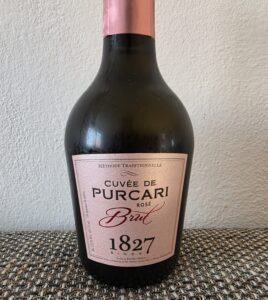
 Today another Moldovan sparkling wine, this time from Purcari. I bought it at the airport and it was truly perfect, so I definitely recommend it if you have the chance to taste it.
Cuvée de Purcari Rosé Brut is a sparkling wine from Château Purcari, one of Moldova’s most renowned wineries. Unlike many modern sparkling wines, it is produced using the traditional method—specifically, through secondary fermentation directly in the bottle. Purcari launched this line of sparkling wines in 2017, collaborating with French sparkling wine expert Jérôme Barret on their production.
Cuvée de Purcari Rosé Brut is crafted from a blend of 60% Pinot Noir and 40% Chardonnay. These are varieties well-known from the Champagne region, making them a logical choice for a sparkling wine produced via the *méthode traditionnelle*.
Pinot Noir is one of the oldest and most genetically significant Western European grape varieties. Its origins are linked to Burgundy, and it belongs to a genetic family closely related to Chardonnay, Pinot Gris, and other Pinot varieties. It primarily contributes structure, fruitiness, a subtle tannic touch, and red berry characteristics to the wine. In the production of rosé sparkling wine, it also plays a key role in defining the color and aromatic complexity.
Chardonnay originated from a natural crossing of Pinot Noir and Gouais Blanc, and its historical home is also in eastern France. Today, it is one of the most widely planted white grape varieties in the world. In sparkling wines, it plays a different role than Pinot Noir, contributing acidity, freshness, citrus and fruit notes, and good potential for bottle aging. The combination of Pinot Noir and Chardonnay is not merely a technical choice; it represents a union of two varieties that have proven their worth over decades in the production of high-quality sparkling wines.
Cuvée de Purcari Rosé Brut is produced using the traditional method, known as *Méthode Traditionnelle* or *méthode champenoise*. The base wine undergoes primary fermentation, after which a *liqueur de tirage* – containing yeast and sugar – is added to the bottle. Secondary fermentation then takes place directly inside the bottle.
It is this stage that generates carbon dioxide, which remains dissolved in the wine and creates the effervescence. The wine subsequently ages in the bottle on its yeast lees. According to Purcari, this extended bottle aging is one of the reasons for the wine’s finer and more persistent effervescence.
In producing its sparkling wines, Purcari also employs gyro-pallet technology for *remuage* – the process of gradually collecting yeast lees at the neck of the bottle.
The history of Château Purcari dates back to 1827, when the first specialized wine estate was established in Bessarabia. However, Purcari’s significance extended well beyond the region as early as the 19th century. In 1878, the Negru de Purcari wine won a gold medal at the World’s Fair in Paris. Over time, Purcari became a symbol of Moldovan winemaking. A key factor in this success is the location of the vineyards in the Ștefan Vodă area, near the Dniester River and relatively close to the Black Sea. The subsoil consists of dark soils overlying limestone, and the local terroir provides suitable conditions for cultivating both red and white grape varieties.
The modern era of Château Purcari’s history began after 2000, with 2003 marking a significant milestone when the winery became part of the Purcari Wineries group. This was followed by investments in vineyards, cellar technology, and production modernization.
Interestingly, sparkling wines represent a relatively new chapter in the history of modern Purcari. As previously mentioned, the Cuvée collection was launched in 2017, yet it quite rapidly garnered attention at international competitions.
Here is a description:
The wine has a delicate salmon-pink color. It appears clean and elegant in the glass, with a delicate, persistent mousse – a result of secondary fermentation and subsequent bottle aging.
The nose reveals floral notes complemented by aromas of blackcurrant and subtle red fruit. At slightly higher temperatures, the fruitier character of the Pinot Noir also emerges. Secondary fermentation and bottle aging add complexity to the aroma, although this is not a sparkling wine defined primarily by pronounced yeasty or toasty notes.
On the palate, Cuvée de Purcari Rosé Brut is fresh, dry, and fruity. Acidity balances the residual sugar (9 g/l). The mousse is fine and persistent, without any aggressive carbonation.
Pinot Noir lends fruitiness and structure, while Chardonnay contributes freshness and an acidic backbone. The finish is medium-long, with lingering fruit notes. The result is a sparkling rosé where the balance between fruitiness, acidity, and effervescence takes precedence over pronounced sweetness.
Alcohol content is 12.5% vol.
Residual sugar is 9 g/l. Classified as Brut, the wine’s residual sugar level explains why it does not feel bone-dry; the sugar is balanced by acidity and carbonation.
Recommended serving temperature is 6-10°C. At the lower end of the temperature range, the wine will feel fresher and crisper, whereas at approximately 8-10°C, its fruity and floral aromas will develop more fully.
Cuvée de Purcari Rosé Brut works well as an aperitif, but its structure also makes it suitable for food pairing. It pairs particularly well with salmon, smoked fish, shrimp, other seafood, sushi, and salmon or tuna tartare. It also complements light salads, poultry, delicate pâtés, soft and mild cheeses, and red-fruit-based desserts. With this type of sparkling rosé, I recommend avoiding very sweet or heavily spiced dishes; it works best with foods where the wine’s acidity and fine effervescence cleanse the palate.
Cuvée de Purcari Rosé Brut sparkling wine has garnered numerous international awards; notable examples include:
- 2026 – gold medal on Concours Mondial de Bruxelles Rosé Session for vintage 2023;
- 2024 – gold medal on Mundus Vini Spring Tasting for vintage 2021;
- 2024 – gold medal on Berliner Wine Trophy for vintage 2021;
- 2024 – silver medal, Vinalies Internationales for vintage 2021;
- 2019 – gold medal on Challenge International du Vin for vintage 2017;
- 2018 – gold medal on Effervescents du Monde for vintage 2016;
- 2018 – gold medal on Challenge International du Vin for vintage 2016;
- 2018 – gold medal on Mondial du Rosé for vintage 2016.
However, awards must always be viewed in the context of a specific vintage. With sparkling wines, individual batches can vary; therefore, the label “Cuvée de Purcari Rosé Brut” does not always signify an identical wine.
Cuvée de Purcari Rosé Brut is an interesting example of how traditional sparkling wine production methods can be adapted to the Moldovan terroir, utilizing the classic blend of international varieties Pinot Noir and Chardonnay.
The varietal ratio is also noteworthy: the slight dominance of Pinot Noir ensures the wine does not come across merely as a white sparkling wine with a pink hue; instead, it possesses a fruitier character and a delicate structure, while retaining ample freshness derived from the Chardonnay. With a residual sugar level of 9 g/l, it falls into the Brut category, while its acidity and effervescence keep the wine balanced.
In the context of Moldovan winemaking, Cuvée de Purcari Rosé Brut is also notable for showcasing a different side of Château Purcari compared to its traditional still red wines – most notably Negru de Purcari. Produced using the *méthode traditionnelle*, this sparkling wine is not merely an addition to the portfolio but a distinct demonstration of the winery’s shift toward a more modern technological approach, all while preserving its historical foundations.
#tipnavino #moldavskevino #moldovawine #purcari #methodetraditionnelle #purcarirosebrut


